
SMT Assembly Services for Prototypes and Production
SMT PCB Assembly Capabilities
- Single & Double-Sided SMT Assembly
- Prototype & Low-Volume Production
- Consigned, Partial Turnkey & Full Turnkey
- Component Sourcing Support
- AOI, X-Ray, ICT & Functional Testing
- BGA, QFN, DFN, CSP & Other SMT Components
- ISO 9001:2015 & ISO 13485:2016
SMT PCB Assembly Services
Unit Circuits provides SMT PCB assembly services for prototypes and low-volume production, supporting component sourcing, PCB fabrication, automated component placement, reflow soldering, inspection, testing, and final assembly.
For OEM projects that require both SMT and through-hole components, we also provide complete PCB Assembly Services with SMT, THT, mixed-technology assembly, component sourcing, and testing support. Send us your Gerber files and BOM for engineering review and quotation.

Get an SMT Assembly Quote
Assemble 20 PCBAS for $0
What is SMT Assembly?
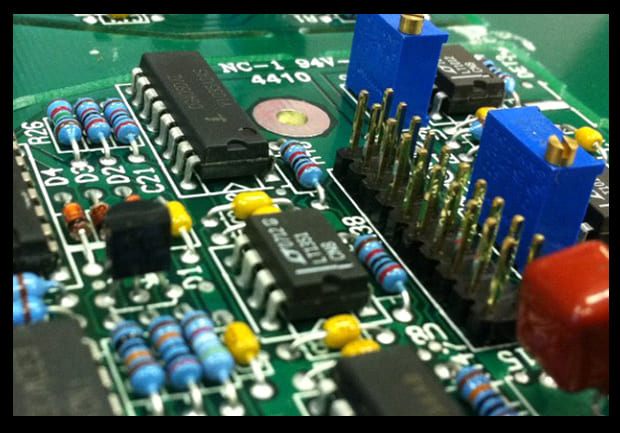
Surface Mount Technology (SMT) assembly is a PCB assembly process in which electronic components are mounted directly onto the surface of a printed circuit board (PCB). Unlike through-hole technology (THT), SMT does not require component leads to pass through drilled holes, allowing higher component density, smaller board designs, and automated production.
A typical SMT assembly process includes solder paste printing, automated component placement, reflow soldering, inspection, and testing. SMT is widely used for modern electronic products because it supports compact designs, high-speed production, and consistent assembly quality.
SMT Assembly Capabilities
Unit Circuits provides SMT assembly services for prototype and low-volume PCB projects, with support for component sourcing, SMT placement, inspection, testing, and turnkey production. Our SMT capabilities support a wide range of electronic products and assembly requirements.
| SMT Capability | Unit Circuits Support |
|---|---|
| Assembly Type | Single-sided & double-sided SMT assembly |
| Production Volume | Prototype & low-volume production |
| Supply Options | Consigned, partial turnkey & full turnkey |
| Component Sourcing | BOM-based component sourcing support |
| SMT Components | SMD, BGA, QFN, DFN, CSP & other SMT packages |
| Inspection | Visual inspection & AOI |
| X-Ray Inspection | Available for BGA and hidden solder joints |
| Testing | ICT & functional testing support |
| Mixed Assembly | SMT + through-hole (THT) assembly |
| Quality Standards | ISO 9001:2015 & ISO 13485:2016 |
For projects combining surface-mount and through-hole components, Unit Circuits also supports mixed-technology PCB assembly from component sourcing through inspection and testing.
Benefits of SMT Assembly
SMT assembly supports compact PCB designs, automated production, and high component density, making it suitable for many modern electronic products. Key advantages include:
1. Compact PCB Designs
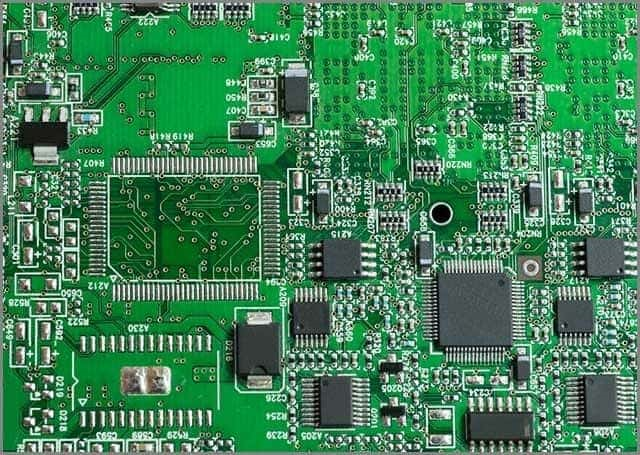
Surface-mount components require less board space than many through-hole components, helping engineers develop smaller and higher-density electronic assemblies.
2. Faster Automated Production
Automated solder paste printing and pick-and-place equipment can increase assembly speed and support faster, repeatable production.
3. High Component Density
SMT supports dense component placement on one or both sides of a PCB, making it suitable for compact and complex electronic designs.
4. Efficient Production at Scale
Automated placement and reflow soldering can improve manufacturing efficiency and consistency, particularly as production volumes increase.
Common SMT Assembly Defects and How We Prevent Them
SMT assembly defects can affect board reliability, electrical performance, and production yield. Common issues include solder bridging, insufficient solder, component misalignment, tombstoning, and solder joint defects. Effective process control and inspection help identify these problems before finished PCB assemblies are shipped.
| Common SMT Defect | Possible Cause | Prevention / Inspection |
|---|---|---|
| Solder Bridging | Excess solder paste or insufficient spacing | Solder paste control and AOI |
| Insufficient Solder | Poor paste transfer or stencil issues | Stencil and solder paste inspection |
| Component Misalignment | Placement or PCB alignment issues | Placement verification and AOI |
| Tombstoning | Uneven heating or solder wetting | Reflow profile optimization |
| BGA Solder Defects | Hidden solder joint or reflow issues | X-ray inspection when required |
At Unit Circuits, SMT assembly quality control can include process inspection, AOI, X-ray inspection for hidden solder joints, and functional testing according to project requirements. These inspection steps help reduce assembly defects and improve consistency from prototype builds to low-volume production.
SMT Assembly Process: From Solder Paste to Testing
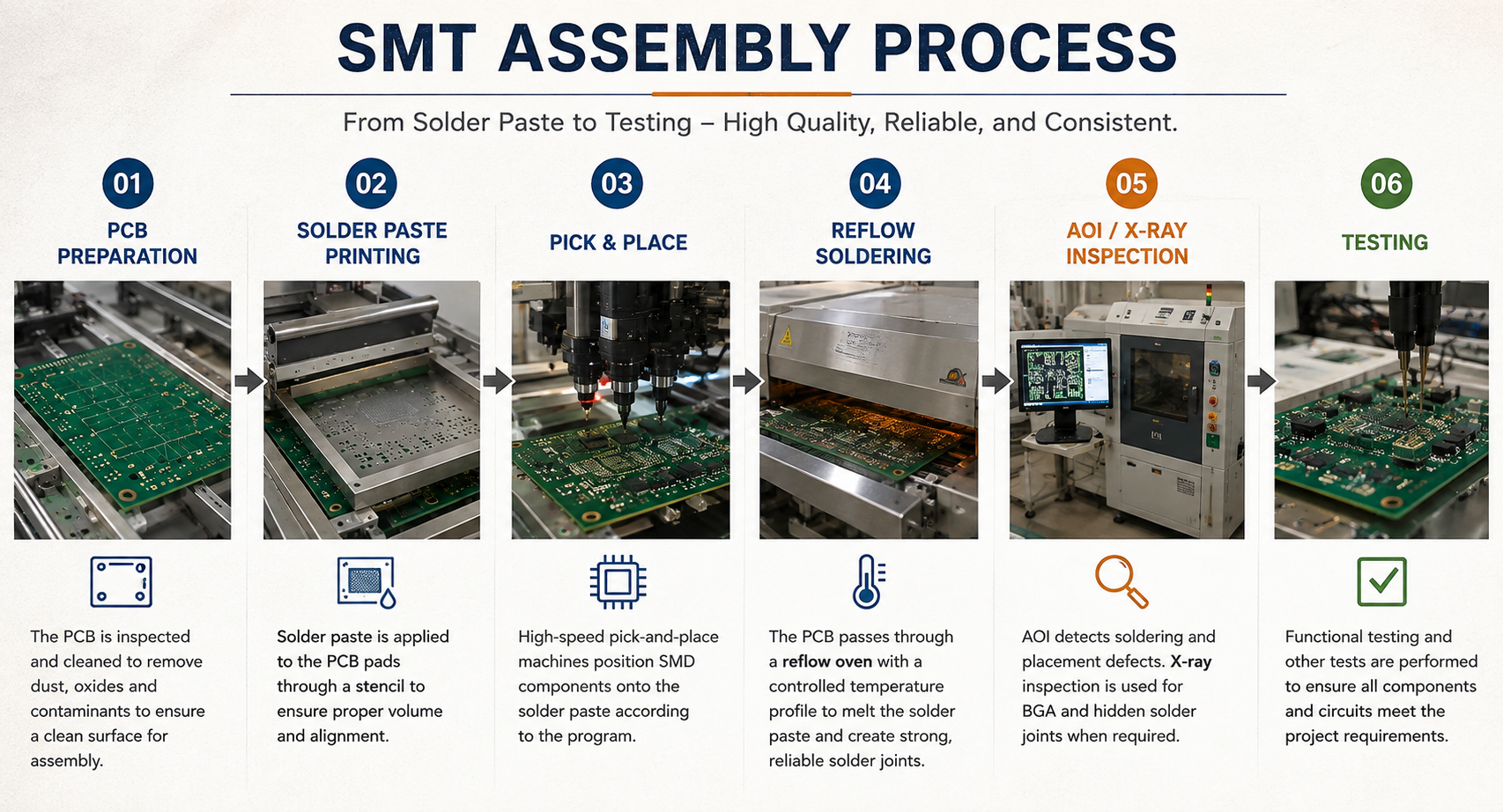
A reliable SMT assembly process requires controlled solder paste printing, accurate component placement, optimized reflow soldering, and thorough inspection. The typical process includes the following stages:
1. PCB Preparation
The PCB is checked and prepared for SMT production to ensure the board surface and assembly data meet manufacturing requirements.
2. Solder Paste Printing
Solder paste is applied to PCB pads through a precision stencil. Proper paste volume and alignment are important for preventing solder bridges, insufficient solder, and other joint defects.
3. Component Placement
Automated pick-and-place machines position SMD components onto the solder paste according to the PCB assembly data.
4. Reflow Soldering
The assembled PCB passes through a controlled reflow oven. The temperature profile is optimized to melt the solder paste and create reliable solder joints without damaging components.
5. Inspection and Testing
After reflow, assembled boards can undergo visual inspection, AOI, X-ray inspection, and functional testing according to project requirements. These checks help identify placement errors, solder defects, and other assembly issues before shipment.
What Affects SMT Assembly Cost?
SMT assembly cost depends on PCB complexity, component count, order volume, component sourcing requirements, stencil setup, testing requirements, and turnaround time. Prototype and low-volume projects may have higher setup costs per board, while larger production runs can reduce the unit assembly cost.
| Cost Factor | Impact on SMT Assembly Cost |
|---|---|
| Order quantity | Higher volumes generally reduce unit cost |
| Component sourcing | Part availability and pricing affect total cost |
| PCB complexity | Fine-pitch, BGA and dense layouts may increase assembly cost |
| Testing | AOI, X-ray, ICT and functional testing add inspection requirements |
| Turnaround time | Expedited production may increase cost |
For accurate pricing, send your Gerber files, BOM, pick-and-place data, quantity, and testing requirements for an SMT assembly quotation.
Why Choose Unit Circuits for SMT Assembly?
Choosing an SMT assembly partner involves more than comparing price and lead time. OEM projects also require reliable component sourcing, process control, inspection, testing, and responsive engineering support.
1. Prototype and Low-Volume Support
We support prototype and low-volume SMT assembly with flexible order quantities, helping engineering teams validate designs before moving to larger production runs.
2. Component Sourcing Support
Our team can source electronic components based on your BOM and project requirements, reducing the time spent coordinating multiple suppliers.
3. SMT Inspection and Testing
Quality control can include visual inspection, AOI, X-ray inspection for BGA and hidden solder joints, and functional testing according to project requirements.
4. Engineering and DFM Support
Before production, our team can review PCB and BOM data to identify potential assembly issues and help reduce avoidable delays or rework.
5. Turnkey PCB Assembly
For projects requiring more than SMT placement, Unit Circuits provides PCB fabrication, component sourcing, PCB assembly, inspection, testing, and shipment coordination through our PCB Assembly Services.
Need a quote for your SMT assembly project? Send us your Gerber files and BOM for a project review and quotation.
FAQs
What files are required for SMT assembly?
For an SMT assembly quote, you typically need to provide Gerber files, a BOM (Bill of Materials), pick-and-place/centroid data, order quantity, and any testing requirements. Assembly drawings or special manufacturing instructions can also be provided when required.
Do you support prototype and low-volume SMT assembly?
Yes. Unit Circuits supports prototype and low-volume SMT assembly with flexible order quantities. This allows OEMs and engineering teams to validate PCB designs, test functionality, and resolve manufacturing issues before moving to larger production runs.
Can you source components for SMT assembly projects?
Yes. Unit Circuits provides component sourcing as part of turnkey PCB assembly. Components can be sourced according to your BOM, manufacturer part numbers, and approved alternatives, helping reduce supplier coordination and component procurement time.
What inspection and testing methods are available for SMT assembly?
Depending on the PCB design and project requirements, SMT assemblies can undergo visual inspection, AOI, X-ray inspection for BGA and hidden solder joints, and functional testing. The appropriate inspection and testing methods are selected according to the board and quality requirements.
What Do You Need for an SMT Assembly Quote?
To provide an accurate quote, please send your PCB manufacturing and assembly files together with your quantity and testing requirements.
- Gerber Files
- BOM
- Pick-and-Place File
- Order Quantity
- Testing Requirements
START YOUR SMT ASSEMBLY PROJECT
Get an SMT Assembly Quote
Ready to start your SMT assembly project? Send us your Gerber files, BOM, pick-and-place data, required quantity, and testing requirements. Our engineering team will review your manufacturing files and project requirements before production.

 Assemble 20 PCBAS for $0