Quick Leads
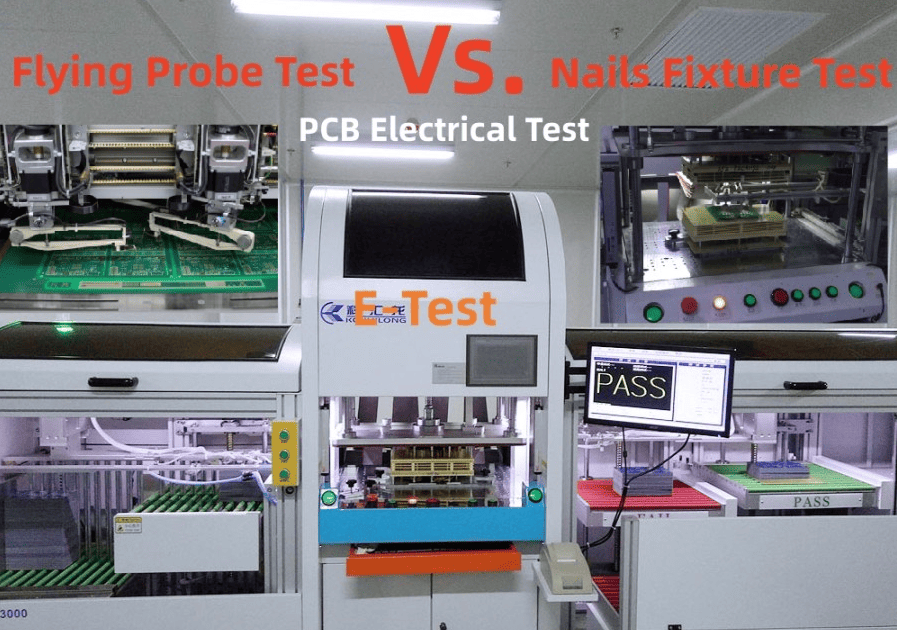
How Does the E-Test Fixture Differ from Flying Probe Testing?
Selecting the Right PCB Testing Method for Quality and Cost Efficiency
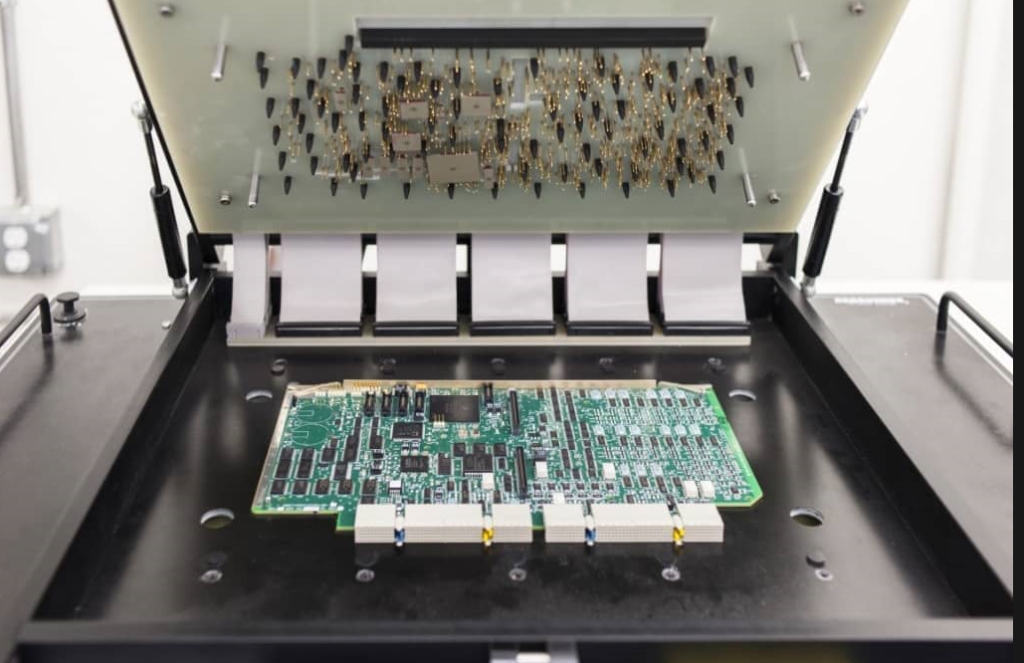
What is an E-Test Fixture for High-Volume PCB Testing?
Advantages:
- High throughput: It’s fast and good for making a lot of PCBs.
- Consistent accuracy: Ensures reliable testing for densely populated boards.
- Scalability: Once set up, the fixture can test thousands of units quickly and efficiently.
Limitations:
- Higher initial cost: It costs a lot to set up the fixture, especially if you have a complicated design.
- Limited flexibility: It’s hard to change the fixture, so it’s not good for changing your design.
Use Cases:
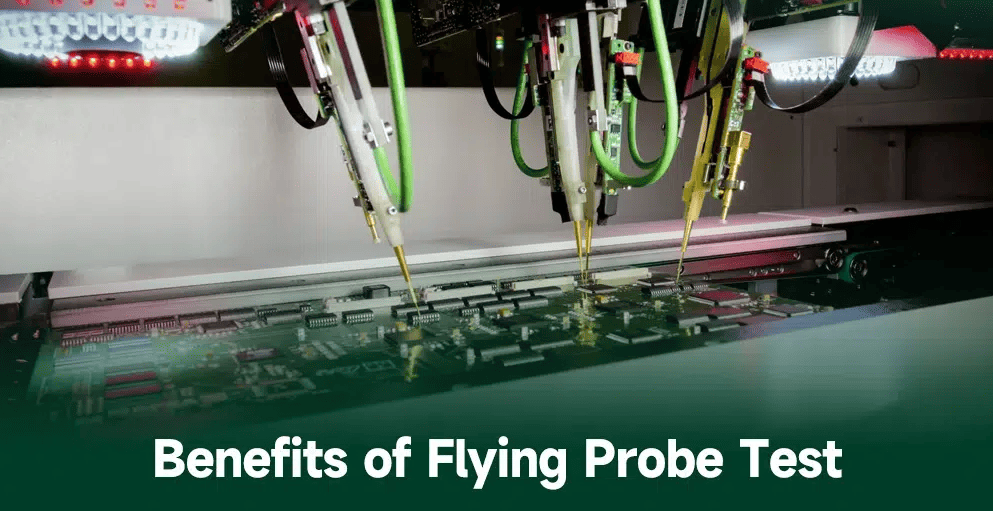
What is Flying Probe Testing for Prototyping and Low-Volume PCB Production?
Advantages:
- Lower initial cost: No fixture needed, reducing upfront expenses, ideal for low-cost PCB testing.
- High adaptability: Accommodates design changes easily without the need for fixture reconfiguration.
- Ideal for complex designs: Suitable for intricate circuits that require flexible, fixture-free testing.
Limitations:
- Slower testing speed: Sequential (point-by-point) testing takes longer than parallel testing.
- Moderate accuracy for high-density boards: Moving probes may struggle with very small test pads, affecting accuracy.
Use Cases:
Preferred in medical device prototyping and low-volume electronics where flexibility and cost control are crucial, and testing speed is less important.
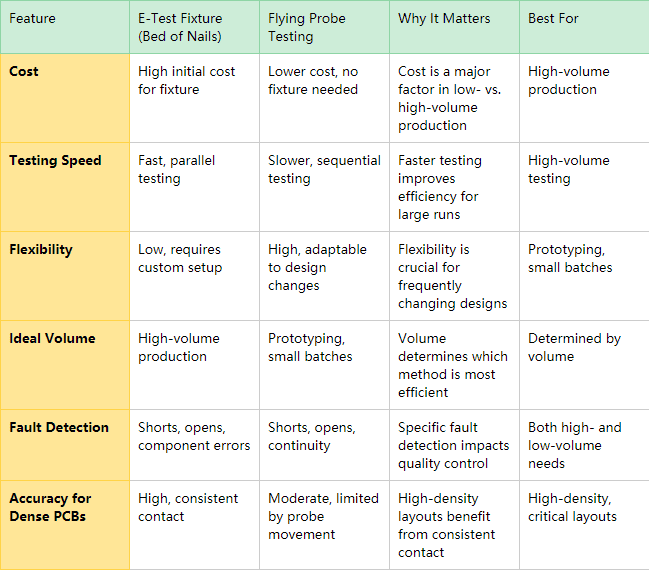
Comparison Table: E-Test Fixture vs. Flying Probe Testing
Types of Faults Detected in PCB Testing
- E-Test Fixture: People use this a lot to check if stuff is connected, if there are shorts, and if the parts are in the right place. You can test a lot of stuff at the same time because the pins touch a lot of points at once, which is good for PCBs with a lot of stuff on them.
- Flying Probe Testing: This way of testing can check if stuff is connected and how much resistance there is by moving probes one at a time to the test points. This way is good for testing prototype circuits when you need to change your design a lot.
Cost and ROI Considerations for PCB Testing Methods
- E-Test Fixture: Even though it costs a lot to set up, this way of testing is a good deal when you’re making a lot of PCBs. For example, if it costs $5,000 to set up the fixture, it might be a good deal if you’re making more than 10,000 PCBs because it saves you time and money on people.
- Flying Probe Testing: This way of testing doesn’t cost a lot to set up, and you can change it, so it’s good for making a few or just one. This way doesn’t cost a lot to change, so it’s good for when you’re just starting out.
Tip: If you’re changing your design a lot, you might want to use flying probe testing so you don’t have to spend a lot of money changing the fixture. If you’re making a lot of the same thing, you might want to use an E-test fixture because it’s faster, you can make a lot of stuff at once, and it’s cheaper in the long run.
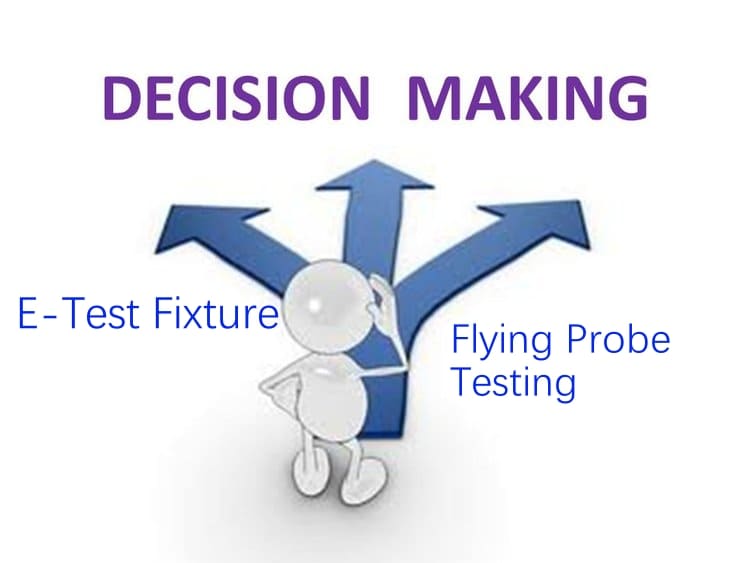
Decision-Making Guide: Which PCB Testing Method is Right for You?
- High-Volume, Stable Designs: Use an E-test fixture for rapid, scalable testing.
- Prototyping and Low-Volume Production: Choose flying probe testing to save on setup costs and gain flexibility.
- Frequent Design Changes: Opt for flying probe testing to avoid reconfiguration costs associated with custom fixtures.
- Complex, High-Density Boards: E-test fixtures offer the accuracy needed for precise contact on densely packed layouts.
Practical Use Cases for E-Test Fixtures and Flying Probe Testing
- 1.Automotive High-Volume Production: For example, a big car company that makes PCBs for the stuff that keeps you safe in your car might use E-test fixtures to make sure that every PCB is good enough to keep you safe, so they don’t have to stop making stuff.
- 2.Medical Device Prototyping: A medical company that’s making a thing you wear to check your heart might use flying probe testing to test stuff fast and change it a lot to make sure it’s right when they’re making a few of them.
- 3.Consumer Electronics with Rapid Design Changes: Companies that make stuff like phones and tablets might use flying probe testing to test stuff when they’re making a few of them and changing it a lot without spending a lot of money to set up the fixture.
Summary: Choosing the Best PCB Testing Method for Your Needs
Limited Time Offer:
Get $100 off your order TODAY!
For more information, visit below:
Request for Quote
Assemble 20 PCBAS for $0
RECENT POSTS

Is Cheap PCB Assembly Really Worth It? Hidden Costs, Quality Risks & What Smart OEMs Avoid
Cheap PCB assembly often hides risks in quality, sourcing, and reliability. Learn how to reduce pcb assembly cost with a trusted pcb assembly manufacturer—get consistent, scalable results today.

An Introduction to 2 Layer PCB: Structure, Benefits, and Manufacturing Tips
Learn what a 2 layer PCB is, how it works, key benefits, layout rules, and manufacturing tips to cut cost. Validate your design faster and get reliable, low‑cost 2 layer PCB assembly support today.
RELATED POSTS
Leading PCBA Manufacturer
✅ Assemble 20 PCBAS for $0 ✅ Get $100 OFF – Risk-Free Trial!
✅ 100+ Satisfied Customers
✅ Ensured Quality & On-Time Delivery
✅ Free Trial, No Commitments!