
Last Updated: August 13, 2026
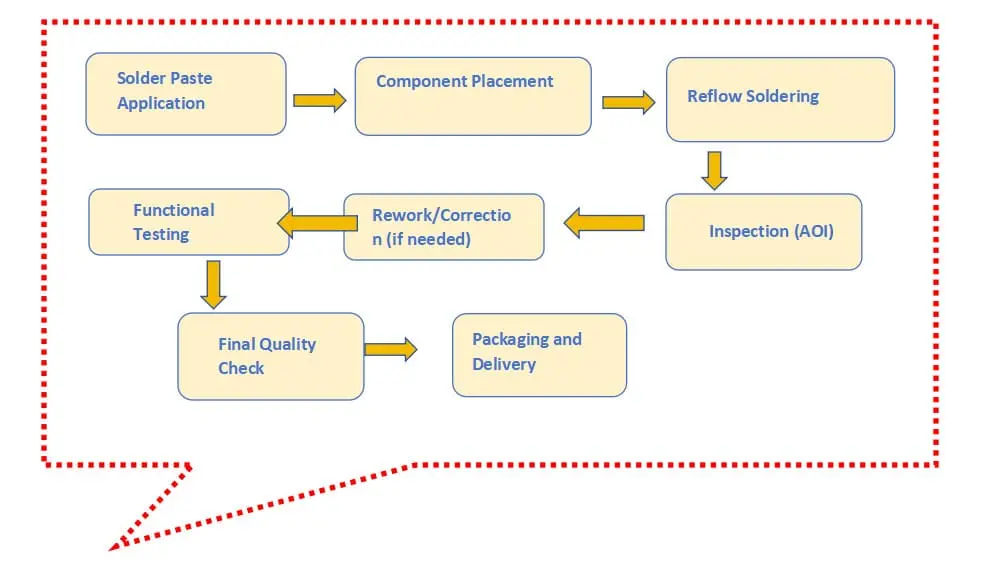
SMT assembly is an automated PCB assembly process used to mount surface-mount components directly onto printed circuit boards. The process typically starts with solder paste printing, followed by component placement, reflow soldering, inspection, and testing.
In this guide, we’ll explain how the SMT assembly process works step by step, the equipment used at each stage, common inspection methods, and where SMT is typically used in electronics manufacturing.
How Does SMT Assembly Work?
SMT assembly works by placing surface-mount devices (SMDs) onto solder paste applied to PCB pads and then passing the board through a reflow oven to form permanent solder joints.
A typical SMT assembly workflow includes:
- PCB preparation – Bare PCBs are checked and prepared for assembly.
- Solder paste printing – Solder paste is deposited onto designated PCB pads through a stencil.
- Pick-and-place – Automated machines position SMD components according to the placement data.
- Reflow soldering – The PCB passes through a controlled temperature profile that melts the solder paste and forms solder joints.
- Inspection – AOI is commonly used to detect placement and soldering defects, while X-ray inspection may be used for hidden joints such as BGA packages.
- Testing – Functional or electrical testing can be performed according to the project requirements.
Each stage affects assembly quality, from solder paste volume and component placement accuracy to reflow temperature control and final inspection.
Quick Leads
SMT Assembly Process Step by Step
1. Solder Paste Printing
A stencil printer deposits a controlled amount of solder paste onto the designated PCB pads.
2. Solder Paste Inspection (SPI)
SPI equipment checks solder paste volume, height, position, and coverage before component placement.
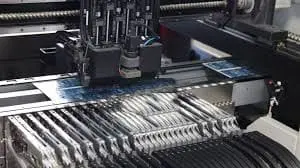
3. Pick-and-Place
Automated pick-and-place machines pick SMD components from reels or trays and position them on the PCB according to the placement data.
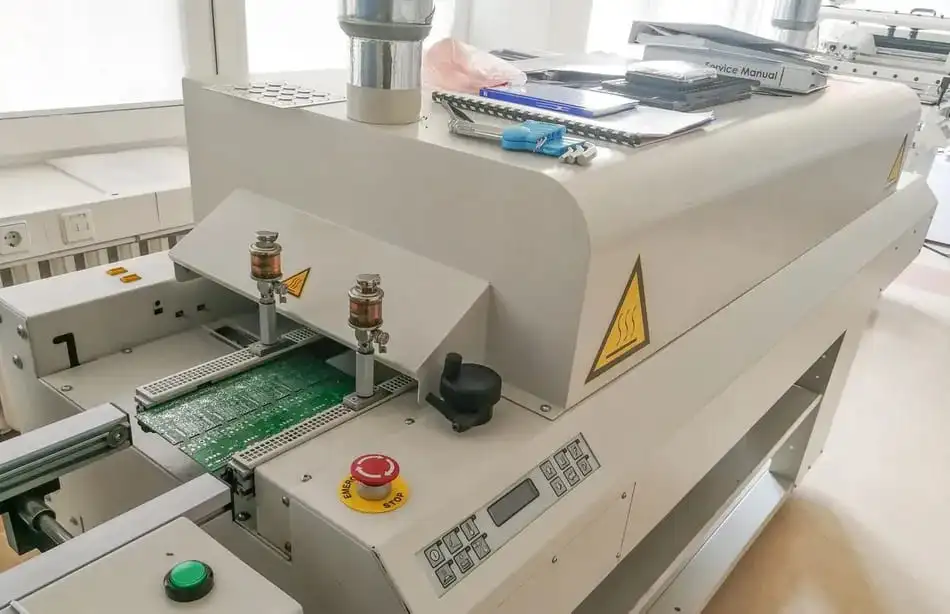
4. Reflow Soldering
The populated PCB passes through a reflow oven with a controlled temperature profile. The solder paste melts and forms permanent electrical and mechanical joints.
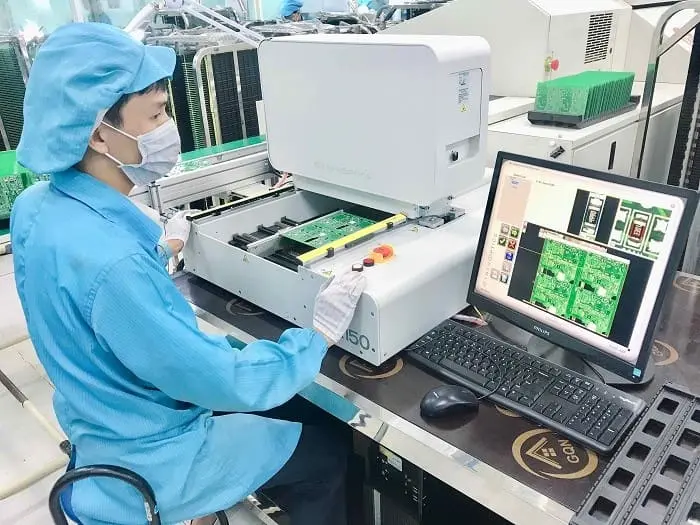
5. AOI and X-Ray Inspection
AOI checks visible solder joints, component position, polarity, and placement defects. X-ray inspection may be used for hidden solder joints, such as those beneath BGA packages.
6. Testing and Final Inspection
Depending on the project, assembled boards may undergo electrical or functional testing before final quality inspection and shipment.
Process control at each stage is important because printing accuracy, component placement, reflow temperature, and inspection all affect the quality and reliability of the finished PCBA. For a more detailed look at production capabilities, equipment, quality control, and manufacturing requirements, see our SMT Assembly Services.
SMT vs. Through-Hole Assembly
| Factor | SMT Assembly | Through-Hole Assembly |
|---|---|---|
| Component mounting | Components mounted on PCB surface | Leads inserted through PCB holes |
| Automation | Highly automated | More manual processing |
| PCB density | Higher | Lower |
| Production speed | Faster for volume production | Generally slower |
| Mechanical strength | Lower for stressed components | Higher for mechanically stressed parts |
| Typical use | Compact, high-density electronics | Connectors, transformers, high-stress components |
Many PCB assemblies use mixed technology, combining SMT components with selected through-hole components when the design requires additional mechanical strength.
What Equipment is Used in SMT Assembly?
Modern SMT assembly lines use automated equipment to control solder paste deposition, component placement, reflow soldering, and inspection. The main equipment includes:
- Stencil Printer: Applies a controlled volume of solder paste to PCB pads through a stainless-steel stencil.
- Solder Paste Inspection (SPI): Measures solder paste volume, height, area, and alignment before component placement.
- Pick-and-Place Machine: Places SMD components onto the solder-paste-coated PCB according to placement data.
- Reflow Oven: Uses a controlled temperature profile to melt the solder paste and form reliable solder joints.
- Automated Optical Inspection (AOI): Checks component presence, polarity, alignment, and visible solder-joint defects after reflow.
- X-ray Inspection: Used when required to inspect hidden solder joints, such as those beneath BGA and other bottom-terminated components.
Together, these machines provide the process control and inspection capability required for consistent SMT production.
Benefits of SMT Assembly
- Higher Component Density: Small SMD packages allow more components to be placed within limited PCB space.
- Faster Automated Production: High-speed pick-and-place equipment supports efficient medium- and high-volume manufacturing.
- Consistent Process Control: Automated printing, placement, reflow, and inspection improve repeatability across production batches.
- Double-Sided Assembly: SMT components can be mounted on both sides of a PCB, providing greater design flexibility.
Common SMT Assembly Defects and How to Prevent Them
| Common Defect | Typical Cause | Prevention / Control |
|---|---|---|
| Solder Bridging | Excess solder paste, stencil or placement issues | Optimize stencil aperture and solder paste volume |
| Tombstoning | Uneven wetting or thermal imbalance | Optimize pad design, paste deposition, and reflow profile |
| Component Misalignment | Placement accuracy or PCB movement | Calibrate placement equipment and verify fiducials |
| Insufficient Solder | Inadequate paste deposition or stencil blockage | Monitor stencil printing and use SPI |
| Solder Voids | Flux outgassing or unsuitable reflow conditions | Optimize paste selection and reflow profile |
| Hidden BGA Defects | Solder joints cannot be visually inspected | Use X-ray inspection when required |
Effective defect prevention starts before reflow. DFM review, stencil design, solder paste control, SPI, placement verification, optimized reflow profiling, and post-reflow inspection all contribute to stable SMT assembly quality.
Conclusion: Building a Reliable SMT Assembly Process
SMT assembly is a highly automated PCB manufacturing process that combines solder paste printing, component placement, reflow soldering, inspection, and testing. Achieving consistent assembly quality depends not only on advanced equipment, but also on proper process control, accurate component placement, optimized reflow profiles, and effective inspection.
For engineers and OEM buyers, understanding these steps makes it easier to evaluate manufacturing capabilities, identify potential quality risks, and choose the right assembly process for a PCB project.
If you are preparing a new PCB assembly project, Unit Circuits provides SMT PCB assembly services, including component sourcing, PCB manufacturing, assembly, inspection, and testing. Explore our SMT PCB Assembly Services for manufacturing support or request a quotation with your Gerber files and BOM.
Frequently Asked Questions (FAQs)
What are the main steps in the SMT assembly process?
The main SMT assembly steps are solder paste printing, solder paste inspection (SPI), component placement, reflow soldering, automated optical inspection (AOI), and functional or electrical testing when required. Additional processes such as X-ray inspection may be used for BGAs and other components with hidden solder joints.
What equipment is used for SMT assembly?
SMT assembly typically uses stencil printers, solder paste inspection (SPI) systems, pick-and-place machines, reflow ovens, and automated optical inspection (AOI) systems. X-ray inspection may also be used for BGAs and other components with hidden solder joints. These machines help control placement accuracy, solder quality, and production consistency.
What are the main benefits of SMT assembly over through-hole assembly?
SMT assembly supports higher component density, faster automated production, and smaller PCB designs than traditional through-hole assembly. Components can also be mounted on both sides of a PCB. Through-hole assembly, however, may be preferred for connectors or components that require greater mechanical strength.
What are the most common SMT assembly defects?
Common SMT assembly defects include solder bridging, insufficient solder, tombstoning, component misalignment, solder voids, and missing or incorrectly placed components. Many of these defects can be reduced through proper stencil design, solder paste control, accurate component placement, optimized reflow profiles, and inspection using SPI, AOI, or X-ray systems.
How is SMT assembly quality inspected?
SMT assembly quality is typically checked at multiple production stages. SPI verifies solder paste deposition before placement, while AOI checks component position, polarity, and visible solder defects after reflow. X-ray inspection can examine hidden joints under BGAs and similar packages. Electrical or functional testing may also be performed according to the PCB assembly requirements.
Limited Time Offer:
Need an SMT Assembly Quote?
 Upload your Gerber files and BOM for a manufacturing review and quotation. Low-volume prototypes and production runs Component sourcing and PCB assembly Inspection and testing options available
Looking for a manufacturing partner? Explore our SMT PCB Assembly Services for component sourcing, PCB assembly, inspection, and testing.
Additional SMT Assembly Resources
- Inspection Methods for Printed Circuit Assembly
Learn how assembled PCBs are inspected for soldering and assembly defects. - How to Audit an SMT Assembly Factory: A Step-by-Step Guide
Key factors to evaluate when selecting an SMT manufacturing partner. - Fiducial Marks in PCB Assembly: What They Are and Why They Matter
Learn how fiducials support accurate automated component placement. - What Is PCBA? PCB Assembly Process and Key Differences from PCB
Understand the difference between a bare PCB and an assembled PCBA.
Request for Quote
RECENT POSTS
Box Build Assembly Explained: One-Stop Turnkey Electronics Manufacturing Solution from China
Discover how turnkey box build assembly integrates PCBA, wiring, enclosures, and testing into ready-to-ship electronic
Insider’s Guide: How to Choose the Best PCB Manufacturer in China (2026 Edition)
Discover how to choose the best PCB manufacturer in China for 2026. Learn about turnkey
RECENT POSTS
Need a PCB Assembly Quote?
✅ Send us your Gerber files & BOM for a review and quotation.
✅ low MOQ for Prototype Orders
✅ Engineering Review Before Production
✅ Fast Quote & Flexible Lead Times