
Quick Leads
SMD Size Codes Explained: A Complete Guide to Understanding Surface-Mount Component Dimensions
Updated for 2026: 2026 Update: 01005 and 0201 packages are increasingly used in AI and IoT applications.

What is SMD Size Code and Why is it Important?
SMD (Surface-Mounted Device) size codes represent the surface mount dimensions of electronic components—such as resistors and capacitors—used in PCB (Printed Circuit Board) assemblies. These standardized codes are essential for ensuring proper component placement, accurate power ratings, and overall manufacturing efficiency.
Engineers often refer to SMD size code charts when selecting components, especially for common package types like 0603 or 0805. However, newcomers may find these codes confusing due to different naming systems used globally for SMD resistor sizes and capacitor codes.
Choosing the correct SMD package size is also essential for reliable SMT assembly, as component dimensions directly affect PCB pad design, solder paste printing, placement accuracy, and inspection.
Besides package size codes, PCB designers should also understand PCB component codes and identification standards used in manufacturing.
Common SMD Sizes
SMD components come in a variety of standardized package sizes, and each SMD size code corresponds to specific surface mount dimensions in either imperial or metric units. These codes help engineers select the appropriate components based on space constraints, electrical requirements, and automated assembly compatibility.
Here are the most common SMD resistor and capacitor sizes:
0201: The smallest standard SMD resistor size, often used in ultra-compact consumer electronics.
0402: Popular in mobile devices where space efficiency is critical.
0603: A balanced size for both consumer and industrial use, offering easier handling and solid electrical performance.
0805: Larger footprint than 0603, ideal for higher current or voltage—frequently compared as 0603 vs 0805 when designing for power vs space.
1206: Common in SMD capacitor codes and power components, used in industrial and high-power applications.
If you’re deciding between these two popular package sizes, read our detailed comparison of 0402 vs 0603 to understand their design and assembly differences.
✅ If you are designing a PCB using these SMD sizes, manufacturing precision becomes critical for yield and reliability.
🔹 Differences Between Imperial and Metric SMD Size Codes
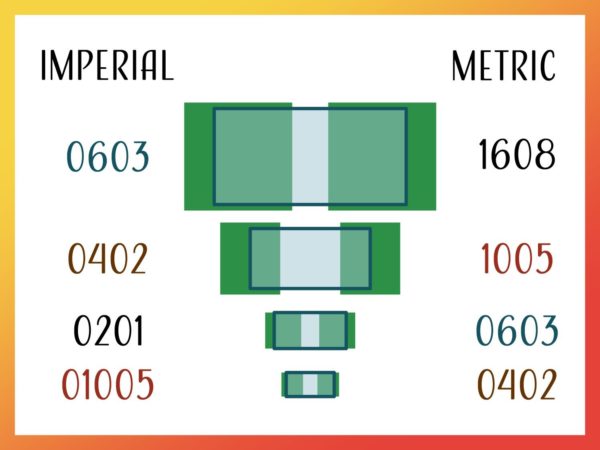
In global electronics manufacturing, SMD size codes are represented in either imperial units (inches) or metric units (millimeters). While the physical components are identical, the way their surface mount dimensions are labeled can vary depending on the region.
Here are two commonly used equivalents:
-
0603 (imperial) = 1608 (metric)
-
0805 (imperial) = 2012 (metric)
This often leads to confusion when comparing packages like 0603 vs 0805 or sourcing components internationally. Understanding these unit systems ensures that the parts you order match your PCB layout and assembly requirements, avoiding costly mistakes in high-density designs.

🔹 How SMD Size Affects Component Layout on the PCB
The size of an SMD component directly affects how densely components can be arranged on a PCB. Smaller packages like 0201 or 0402 enable compact layouts but require high-precision placement equipment and tighter process control. On the other hand, larger packages like 0805 or 1206 allow for easier handling and more forgiving tolerances during assembly.
Choosing between sizes such as 0603 vs 0805 often comes down to a trade-off between space savings and manufacturing reliability. These choices impact your overall surface mount layout and can affect everything from solder joint quality to inspection and testing.
For projects requiring professional component placement and manufacturing support, choosing the right PCB assembly partner is essential. Unit Circuits provides PCB assembly services including SMT assembly, component sourcing, inspection, and testing for prototype and production projects.
🔹 Common SMD Package Types and Sizes
SMD components come in various package types, each defined by its unique size code that corresponds to specific physical dimensions and electrical properties.
Resistors: Most common SMD resistor sizes include 0603, 0805, and 1206, depending on power handling and board space.
Capacitors: Similar in packaging to resistors, but often listed under separate SMD capacitor codes, with smaller packages like 0402 used in high-density designs.
Transistors: Typically found in slightly larger packages such as SOT-23, or surface-mount equivalents of 0603/0805, especially in analog and switching circuits.
Each component’s size selection impacts not just placement but also thermal behavior, current handling, and yield rate during assembly. For a complete overview of package options, check our PCB parts code guide for decoding markings.
💡 As component sizes become smaller, PCB assembly quality becomes more important than design alone.

🔹 How to Choose the Right SMD Size
Choosing the correct SMD size is crucial for balancing performance, manufacturability, and cost. Several factors influence the decision:
Application Type: Smaller packages like 0402 or 0201 are ideal for compact devices such as smartphones or wearables. In contrast, larger packages like 0603, 0805, or 1206 are preferred in power supply, industrial control, or high-current applications.
Power Handling: Generally, the SMD resistor size increases with power rating. For instance, 0805 resistors can typically handle more power than 0402, which is essential for thermal stability.
Manufacturing Process: While smaller sizes allow for dense layouts, they also require more precise equipment and are harder to inspect or rework. This adds complexity and cost during production.
Selecting between packages like 0603 vs 0805 depends on your priorities—whether it’s saving space, increasing reliability, or improving yield rate. These trade-offs directly impact your surface mount layout and long-term performance.
👉 After selecting suitable components, the next step is ensuring reliable PCB production and assembly. Working with an experienced PCB assembly partner can help reduce sourcing and manufacturing risks.
🔹 SMD Size Chart: Power Handling and Applications
As a general rule, power handling increases with package size. Larger components have wider pads and more copper contact area, enabling better heat dissipation.
Here’s a simplified comparison:
| SMD Size | Typical Power Rating | Recommended Use |
|---|---|---|
| 0402 | 0.063W | Mobile devices, signal lines |
| 0603 | 0.10W | Consumer electronics, sensors |
| 0805 | 0.125–0.25W | Power circuits, motor drivers |
| 1206 | 0.25–0.50W | Industrial, automotive systems |
🧠 Proper size selection prevents overheating, improves solder joint quality, and reduces long-term failure rates.

🔷 2026 Industry Trend Update: SMD Component Miniaturization
In 2026, the electronics industry continues moving toward smaller components and higher-density PCB designs, driven by AI hardware, IoT devices, electric vehicles, and wearable electronics.
📌 1. Smaller Packages Are Becoming Standard
Traditional SMD sizes such as 0603 and 0402 are still widely used in general electronics.
However, advanced applications are increasingly shifting toward smaller packages:
- 0201 (0603 metric) → now common in high-density mobile and IoT products
- 01005 → widely used in ultra-compact wearables and RF modules
- 008004 (0201 metric) → emerging in AI and high-frequency applications
👉 The industry trend is clear:
PCB designs are becoming smaller and more integrated.
📌 2. Key Industry Drivers
This miniaturization trend is mainly driven by:
- AI servers requiring higher component density
- Electric vehicles (EVs) needing compact control systems
- IoT sensors with strict size limitations
- Wearable devices requiring ultra-small form factors
- 5G / RF systems needing reduced parasitic effects
📌 3. Impact on PCB Design & Assembly
As components become smaller, PCB manufacturing and assembly require:
- Higher precision SMT placement
- More accurate solder paste printing
- Advanced inspection systems (AOI / SPI / X-ray)
- Tighter process control in fabrication
👉 Manufacturing capability is now as important as circuit design.
📌 4. What Engineers Should Consider
When selecting SMD sizes in 2026, engineers should balance:
- Product size constraints
- Manufacturing capability of the PCB supplier
- Cost vs performance trade-offs
- Long-term reliability in high-density designs
📌 5. How We Support These Trends
At Unit Circuits, we support advanced PCB assembly including:
- 01005 / 0201 / fine-pitch components
- High-density SMT assembly
- Prototype to mass production PCB manufacturing
- Turnkey PCB assembly with component sourcing
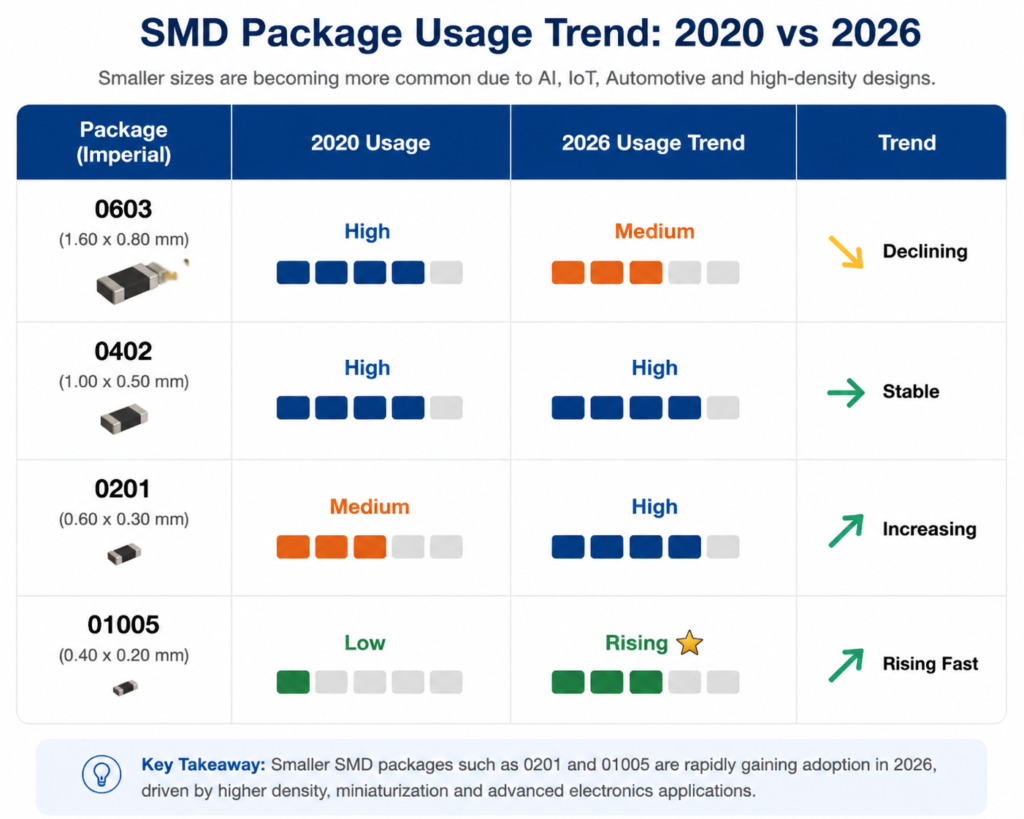
This trend reflects the increasing demand for compact and high-density PCB assembly in modern electronics manufacturing.
FAQs
1. What is the smallest SMD size in 2026?
The smallest commonly used SMD sizes in 2026 are 01005 and 008004 packages, mainly used in advanced applications such as AI hardware, RF modules, wearable devices, and ultra-compact IoT products. These components require extremely high precision in PCB design and assembly.
2. What is the difference between 0402 and 0201 SMD components?
The main difference is physical size and application density.
- 0402 is still widely used in general consumer electronics and offers easier assembly and lower cost.
- 0201 is significantly smaller and used in high-density designs where PCB space is limited.
0201 components require more advanced PCB assembly capability due to their size.
3. Which SMD size is best for high-frequency circuits?
For high-frequency applications such as RF and 5G circuits, smaller SMD sizes like 0201 or 01005 are preferred because they reduce parasitic capacitance and inductance, improving signal integrity and performance.
4. How to choose the right SMD size for PCB assembly?
When selecting SMD sizes, engineers should consider:
- Available PCB space
- Electrical performance requirements
- Manufacturing capability of the PCB assembly supplier
- Cost and production yield
- Product reliability requirements
A balance between performance and manufacturability is essential.
5. Does SMD size affect PCB manufacturing cost?
Yes, SMD size can impact cost.
Smaller components such as 0201 and 01005 generally increase manufacturing complexity, requiring:
- Higher precision SMT placement machines
- Advanced inspection systems
- Tighter process control
This can increase assembly cost, but improves product miniaturization and performance.
6. Are smaller SMD components more reliable?
Not necessarily. Smaller components are more sensitive to manufacturing accuracy and process control. When assembled correctly using advanced PCB manufacturing techniques, they can be highly reliable even in demanding applications such as automotive and aerospace electronics.
7. What industries are driving the use of smaller SMD sizes in 2026?
Key industries include:
- Artificial Intelligence (AI) hardware
- Electric Vehicles (EV)
- IoT devices
- Wearable electronics
- 5G and RF communication systems
These industries require compact, high-density PCB designs.
8.Can PCB assembly services handle 01005 and 0201 components?
Yes, but only manufacturers with advanced SMT capabilities can handle such small components. At Unit Circuits, we support high-precision PCB assembly including 01005, 0201, and other fine-pitch components for prototype and mass production.
8.Can SMD components affect PCB assembly cost?
Yes. Package size, component density, and assembly requirements can affect PCB assembly complexity and cost.
Limited Time Offer:
Get $100 off your order TODAY!
 Trusted by 100+ businesses worldwide No hidden fees – transparent pricing Guaranteed quality with on-time deliver
🔹 Conclusion
Understanding SMD size codes is essential for selecting the right resistors, capacitors, and other surface-mount components for your project. By learning how these codes relate to surface mount dimensions, you can ensure proper fit, optimize your PCB layout, and meet power or performance requirements effectively.
Whether you’re choosing between 0603 vs 0805 or specifying SMD resistor sizes for your board, making the right decision at this stage will streamline your manufacturing process and reduce the risk of costly errors.
✅ Want to ensure your supplier’s SMT line meets international standards?
Check this [factory audit checklist for SMT manufacturers in China]
Need help sourcing these components or assembling your PCB?
Related PCB Assembly Resources:
- 0402 vs 0603 Comparison – Choose the right package for your PCB design.
- PCB Components & Codes Guide – Understand electronic component identification standards.
- PCB Assembly Services – Explore our SMT and turnkey manufacturing capabilities.
✅ Related PCB Design Guides

What Do Capacitor Symbols Mean in PCB Design? A Guide for IoT Engineers and PCB Assembly Decision-Makers
Learn about capacitor symbols in PCB design for IoT products. Discover the different types of
How to Safely Discharge a Capacitor for High-Quality IoT Devices: A Step-by-Step Guide for Engineers
Learn the safe and effective methods for discharging capacitors using a multimeter, essential for IoT
RELATED POSTS
Leading PCB Assembly
✅ Assemble 20 PCBAS for $0 ✅ Get $100 OFF – Risk-Free Trial!
✅ 100+ Satisfied Customers
✅ Ensured Quality & On-Time Delivery
✅ Free Trial, No Commitments!